

Why Productivity Growth Has Stalled: New Research Shows Leadership Systems — Not People — Are the Bottleneck
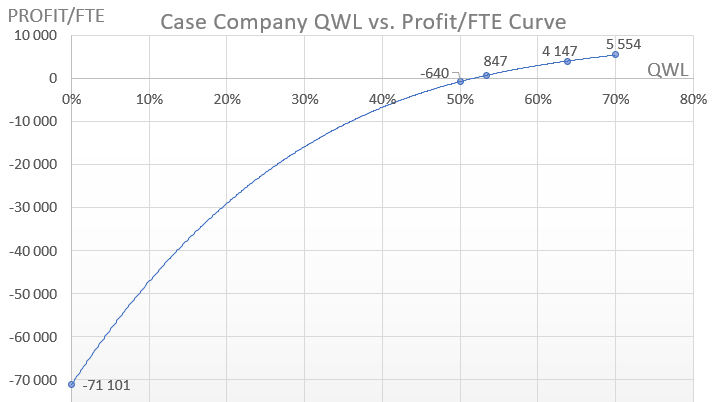
Figure 1 illustrates how Quality of Working Life (QWL) functions as a production factor rather than a soft wellbeing indicator. Once the organization surpasses the break-even threshold, improvements in QWL translate into accelerating profitability.

DI, HTT, Dosentti Marko Kesti
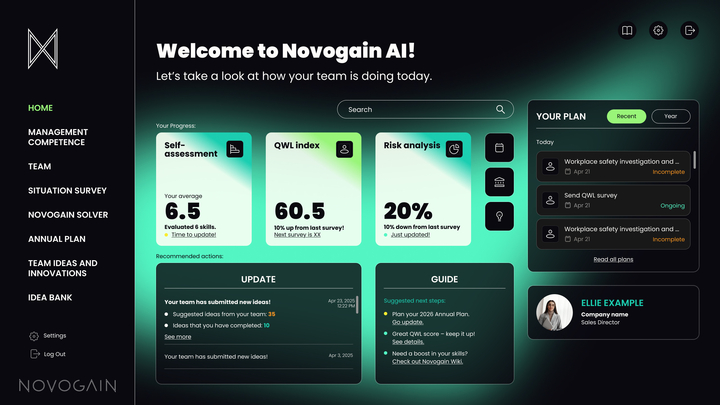
Welcome to Novogain AI assistant
Why Productivity Growth Has Stalled: New Research Shows Leadership Systems — Not People — Are the Bottleneck
Long-term research on human capital productivity shows that organizations systematically underuse employees’ experience, expertise, and tacit knowledge. While these intangible assets are present, leadership practices and organizational structures often fail to convert them into customer value and profit.
What Supervisors Say Is Blocking Productivity
A recent study involving 227 supervisors provides concrete insight into what prevents productivity development at the team level. When asked to identify the most significant barriers they face, supervisors reported:
• Lack of time to solve underlying problems (18.9%)
• Short-term result and cost management overriding people leadership (16.7%)
• Insufficient people leadership skills (16.3%)
• Leadership practices that are not systematic or proactive (11.1%)
These findings point to a systemic issue rather than individual performance problems. Supervisors are held accountable for results, yet the organizational environment restricts their ability to lead in a way that builds sustainable productivity.
Productivity Follows a Human Capital Production Function
From a human capital perspective, productivity is not primarily driven by headcount or working hours. Instead, it follows a Human Capital Production Function, where organizational output depends on workforce capacity, effective working time, and the degree to which human capital is utilized.
A central production factor in this model is Quality of Working Life (QWL). QWL reflects how well employees’ competence, experience, collaboration capability, and motivation are translated into productive customer value.
When QWL is low, organizations may still carry all fixed costs—such as personnel expenses and administration—yet fail to generate sufficient revenue. This is not merely a theoretical assumption; it is a mathematical and empirical fact. If human capital cannot be utilized, value creation collapses.
Empirical Evidence: The Treili Case
The relationship between Quality of Working Life (QWL) and profitability can be demonstrated using real organizational data. One such case is Treili. According to independent HR research published in Työn Tuuli (1/2024), Treili’s QWL index increased significantly over a two-year period, accompanied by measurable improvements in productivity and profitability. Using the Human Capital Production Function, this development can be analyzed to illustrate how changes in QWL affect financial performance.
At a hypothetical baseline where QWL equals zero, Treili would generate no customer value. Revenue collapses to zero while personnel and fixed costs remain unchanged. In this scenario, the company’s EBITDA is –€12.7 million, corresponding to –€71,101 per employee. This outcome is mathematically unavoidable and defines the lower boundary of human capital utilization.
As QWL improves, customer value creation increases. When QWL reaches 50%, Treili approaches break-even. At this level, EBITDA remains slightly negative at –€640 per employee. This indicates that moderate employee experience levels are insufficient to offset fixed costs in human-capital-intensive organizations.
Beyond this threshold, profitability accelerates rapidly. At 53.4% QWL, Treili achieves positive EBITDA of €847 per employee. With further leadership and organizational development, QWL increases to 63.8%, resulting in an EBITDA of €4,147 per employee. At 70% QWL, profitability will rise further to approximately €5,500 per employee.
Importantly, these gains occur even as auxiliary development time increases. Although more time is invested in leadership, coordination, and continuous improvement, net productivity improves substantially. This confirms that well-targeted development functions as a productive investment rather than a cost.
The empirical data demonstrates a non-linear relationship between QWL and profitability. Once an organization surpasses the break-even threshold, incremental improvements in QWL generate disproportionately large financial returns.
The Productivity Trap
The research highlights a recurring pattern across organizations. In an effort to improve efficiency, leadership systems emphasize short-term financial control and resource tightening. While this may improve short-term figures, it simultaneously reduces supervisors’ ability to address root causes, develop teams, and build long-term productivity.
This creates a productivity trap: leadership becomes reactive, QWL remains too low, and productivity stagnates—despite increasing pressure and effort.
From Measurement to Action: The Role of AI
Raising QWL as a production factor requires more than annual surveys or isolated training programs. It requires leadership systems that are proactive, data-driven, and capable of guiding everyday managerial decisions.
This challenge has led to the development of Novogain AI, an AI-based leadership solution designed to improve QWL systematically at the team level. Novogain AI integrates the key drivers of staff performance and wellbeing—including leadership practices, workload structure, collaboration quality, and development activities—into a digital twin of each team.
By simulating the impact of different leadership actions on QWL, productivity, and financial outcomes, the system helps supervisors focus on actions that improve human capital utilization rather than merely reacting to short-term pressures. The objective is not to maximize wellbeing in isolation, but to optimize QWL as a strategic production factor that drives both customer value and sustainable profitability.
Rethinking Productivity Growth
The findings suggest that Europe’s productivity challenge cannot be solved by education alone or by pushing employees harder. The capability already exists. What is missing are leadership systems that allow supervisors to use that capability effectively.
“Productivity is not lost because people lack competence; it is lost because leadership systems do not give supervisors the time, tools, or structures needed to convert human potential into value.” Kesti states.
As organizations seek sustainable competitiveness, managing human capital as a true production factor—measured, modelled, and actively developed—will be essential.
About the Researcher
Dr. Marko Kesti is a Docent (Adjunct Professor) of Human Capital Productivity at the University of Lapland. His work focuses on leadership systems, Quality of Working Life (QWL), and the economic utilization of human capital.
About Novogain AI
Novogain AI is an AI-based leadership solution that supports evidence-based decision-making to improve human performance and long-term business outcomes.
Kesti Marko
Novogain
+358 407178006
marko.kesti@ulapland.fi
Visit us on social media:
LinkedIn
YouTube
Novogain AI short presentation and contact information
Legal Disclaimer:
EIN Presswire provides this news content "as is" without warranty of any kind. We do not accept any responsibility or liability for the accuracy, content, images, videos, licenses, completeness, legality, or reliability of the information contained in this article. If you have any complaints or copyright issues related to this article, kindly contact the author above.
