

Pickleball Market to Reach USD 3.50 Billion by 2032 at 10.2% CAGR: Maximize Market Research
Pickleball Market
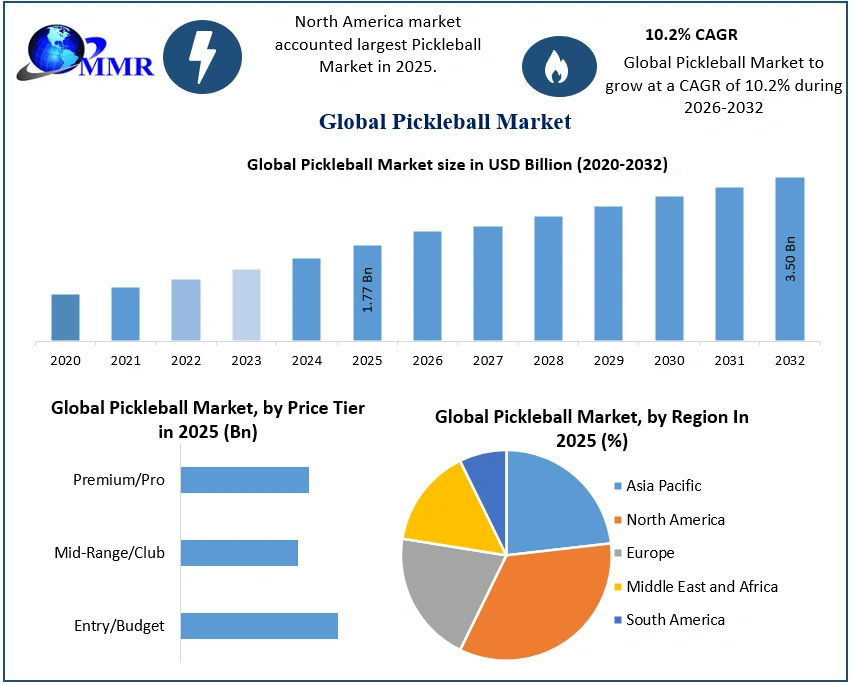
The Pickleball Market was valued at USD 1.77 billion in 2025 and is projected to reach USD 3.50 billion by 2032, growing at a CAGR of 10.2%.
The youth takeover is here: Maximize Market Research highlights the 18–34 demographic now dominating 29% of the global player base.”
ROCKVILLE , MD, UNITED STATES, March 18, 2026 /EINPresswire.com/ -- The global Pickleball Market has officially graduated from a localized recreational trend to a dominant pillar of the international "Social Fitness" economy. Valued at USD 1.77 Billion in 2025, the market is projected to reach USD 3.50 Billion by 2032, sustained by a high-velocity CAGR of 10.2%. This surge is no longer localized to senior active-living communities; instead, March 2026 data indicates a massive demographic tilt, with the 18–34 age group now representing the largest segment at approximately 28.8% of the participant base. A prime example of this commercial mainstreaming is seen in the corporate sector, where major entities like Myntra have recently inaugurated dedicated in-house pickleball facilities to foster employee wellness and camaraderie. This shift has transformed the sport into a "Lifestyle Essential," where the court serves as the new "third space" for networking and mental health.— Maximize Market Research
Get Full PDF Sample Copy of Report: (Including Full TOC, List of Tables & Figures, Chart) @ https://www.maximizemarketresearch.com/request-sample/214433/
According to latest industry observations, the "Pickleball Effect" is reshaping urban infrastructure. As developers scramble to meet the demand, the sport is being integrated into luxury residential projects as a marquee amenity to attract younger, active buyers. This cultural mainstreaming is further catalyzed by celebrity-backed professional leagues, which have elevated pickleball from a backyard hobby to a high-stakes commercial asset. By fostering an inclusive environment that prioritizes social connectivity, the market is successfully capturing a diverse global audience, ensuring long-term economic resilience.
"Quiet-Tech" Innovation – Solving the Noise-Control Crisis
As pickleball scales globally, the industry is undergoing a high-tech metamorphosis to address its most significant growth barrier: noise pollution. The market is being revitalized by a new "Quiet Category" of equipment, moving away from traditional honeycomb polymer cores that produce a high-frequency "ping." The current technical gold standard is the "Gen-4" full-foam core and Acoustene composite surfaces, which are engineered to absorb acoustic energy rather than amplify it. A definitive real-world application is the "Silencer Pro" series, which has become the first USAP-approved paddle to reduce decibel levels by 50% while maintaining tournament-level power and spin. This material innovation is essential for resolving the rising wave of community disputes and HOA restrictions. By integrating these vibration-damping technologies, manufacturers are effectively "de-risking" the sport’s expansion into densely populated urban and residential areas, ensuring a harmonious balance between athletic intensity and local tranquility.
Retail-to-Recreation – Adaptive Reuse as a Market Growth Catalyst
The rapid expansion of the sport is currently being propelled by a significant shift in commercial real estate, where underutilized retail "big-box" stores are being transformed into premier indoor athletic hubs. This "Adaptive Reuse" trend is solving the critical shortage of court space while providing a vital foot-traffic lifeline for struggling shopping centers. Property developers are increasingly favoring the sport’s compact footprint, which allows for multiple courts to be integrated into spaces that formerly housed department stores or warehouses. A prominent real-world example of this evolution is the Rhythm & Rally facility in Macon, which repurposed a former Belk anchor store into one of the world’s largest indoor complexes, featuring 32 climate-controlled courts.
By converting these "dead" retail assets into "eatertainment" destinations—combining high-end dining with professional-grade courts—operators are tapping into a high-spending player demographic. This structural evolution is a primary engine behind the sport's upward trajectory, as indoor venues allow for year-round, weather-independent play. This synergy between recreation and real estate ensures that the industry remains insulated from seasonal fluctuations, securing its position as a long-term commercial asset.
Market Dynamics – The Multi-Generational Growth Engine
The transition toward a USD 3.50 Billion valuation is being driven by a fundamental shift in player demographics and the rapid professionalization of the sport. While historically viewed as a senior-friendly activity, March 2026 data reveals that the 18–34 age group has emerged as the largest participating segment, accounting for approximately 28.8% of the global player base. This "Youth Takeover" is creating a massive secondary market for high-performance apparel and "pro-sumer" grade equipment. A definitive real-world milestone of this momentum occurred in late 2025, when the "Pickle Breakers" set a staggering Guinness World Record by playing for 49 consecutive hours, raising significant funds for charitable causes. This blend of competitive endurance and community-driven purpose is the "secret sauce" behind the 10.2% CAGR, as the sport evolves into a year-round, high-engagement commercial ecosystem.
Regional Expansion – The "Global Smash" and the APAC Surge
While North America historically dominated the sport’s infrastructure, March 2026 marks the definitive shift toward the Asia-Pacific (APAC) region as the primary engine of future market volume. With a staggering 60% year-on-year growth rate across the continent, countries like India, China, and Vietnam are leveraging their deep-rooted racket sport cultures to rapidly scale participation. A definitive real-world milestone of this expansion is seen in India, where the number of dedicated courts in Mumbai alone has jumped five-fold to 500 facilities within the last year. This regional boom is being further catalyzed by the launch of the Major League Pickleball (MLP) Asia in 2026, which is establishing a professional franchise ecosystem across the "ASEAN-Pickleball" corridor. As disposable incomes rise and urban "Smart-City" planners prioritize accessible recreation, the APAC market is poised to become the sport's largest global demographic by 2032.
Market Segmentation – Precision Engineering and High-Performance Gear
The 2026 market structure is defined by a clear division between high-volume equipment and high-margin specialized apparel. The Equipment segment remains the dominant force, accounting for nearly 41.5% of global revenue, fueled by the rapid replacement cycle of carbon-fiber paddles and "USAP-approved" quiet-tech balls. Simultaneously, the Footwear segment is emerging as a high-growth vertical, expanding at a 15.4% CAGR as players seek specialized lateral-support shoes to prevent common court injuries. A notable real-world example is Reebok’s recent launch of the Nano Court, a dedicated footwear line designed specifically for the unique multidirectional friction and stability requirements of professional-grade pickleball play.
Get Full PDF Sample Copy of Report: (Including Full TOC, List of Tables & Figures, Chart) @ https://www.maximizemarketresearch.com/request-sample/214433/
By Based on Product Type
Equipment
Paddles
Balls
Nets & Court
Equipment
Training & Coaching Gear
Smart/Connected Gear
Apparel
Tops
Bottoms
Outerwear
Performance Attributes
Collections
Footwear
Pickleball-specific Court Shoes
Multi-court Shoes
Stability vs Lightweight
Wide-fit Options
Accessories
Bags & Backpacks
Grips & Overgrips
Edge Tape
Vibration Dampeners
Wristbands & Caps
Eyewear
Towels
Socks
Court Infrastructure
Modular Court Flooring
Resurfacing & Coatings
Lighting
Fencing
Benches
Scoreboards
By Based on Price Tier
Entry/Budget
Mid-Range/Club
Premium/Pro
By Based on Gender
Individual Consumers
Skill Level
Institutional/B2B
Team/League Purchasers
Analyst Perspective – Pickleball as a New "Real Estate Asset Class"
Strategic analysts identify a fundamental shift where pickleball is moving from a "line-item amenity" to a primary "Real Estate Asset Class." In the 2026 landscape, the USD 3.50 Billion market is being fueled by "Adaptive Reuse" strategies, where developers prioritize court density over traditional multi-sport layouts. A definitive real-world example is the Hiranandani Group’s integration of the CXO PickleBall League into their business parks, positioning the sport as a high-value networking platform for corporate leadership. This evolution into a "Lifestyle Differentiator" is transforming rooftops and vacant retail anchors into high-yield "Eatertainment" hubs. By 2032, success will be defined by "Smart-Facility" designs that blend professional-grade athletics with hospitality-driven social ecosystems.
Pickleball Market Key players
Onix Pickleball
Franklin Sports
Selkirk Sport
Paddletek
Engage Pickleball
Head Pickleball
Gamma Sports
ProLite Sports
Vulcan Sporting Goods
Wilson Sporting Goods
Pickleball Inc.
Gearbox Sports
PickleballCentral
PickleballDepot
PickleballNow
Get access to the full description of the report @ https://www.maximizemarketresearch.com/market-report/pickleball-market/214433/
FAQ’s
Q1: Why is the Pickleball Market projected to reach USD 3.50 Billion by 2032?
Ans: Expansion is fueled by a 10.2% CAGR and a massive demographic shift, where players aged 18–34 now account for nearly 29% of global participation.
Q2: How is "Quiet-Tech" affecting equipment sales in 2026?
Ans: New "USAP Quiet-Approved" gear, such as the Silencer Pro series, reduces noise by 50%, allowing courts to expand into noise-sensitive residential areas and HOAs.
Q3: What role does "Adaptive Reuse" play in court infrastructure?
Ans: Developers are repurposing vacant retail "big-box" stores into high-yield indoor hubs, like the Rhythm & Rally facility which converted a former department store into 32 courts.
Q4: Is Pickleball becoming a corporate networking tool?
Ans: Yes; major firms like Myntra and the Hiranandani Group have integrated dedicated facilities into their business parks to foster employee wellness and executive networking.
Related Reports
Sports Coaching Platforms Market: https://www.maximizemarketresearch.com/market-report/sports-coaching-platforms-market/147465/
Racket Sports Equipment Market: https://www.maximizemarketresearch.com/market-report/global-racket-sports-equipment-market/103803/
Sports Equipment and Apparel Market: https://www.maximizemarketresearch.com/market-report/global-sports-equipment-and-apparel-market/20987/
Space Technology (SpaceTech) Market: https://www.maximizemarketresearch.com/market-report/space-technology-spacetech-market/215567/
Top Reports:
Global Organic Waste Market
Global Wire Enamels Market
About Maximize Market Research
Maximize Market Research is a global business consulting entity specializing in high-impact industrial shifts. We empower Fortune 500 organizations with data-driven strategies to navigate complex market cycles and secure long-term dominance.
Domain Focus: Consumer Goods & Services
Our team evaluates high-performance lifestyle ecosystems, analyzing the lifecycle economics of social-fitness infrastructure, from adaptive-reuse real estate and quiet-tech acoustic engineering to the integration of professional-grade pickleball hubs into the global experience economy.
Lumawant Godage
MAXIMIZE MARKET RESEARCH PVT. LTD.
+ +91 96073 65656
email us here
Visit us on social media:
LinkedIn
Instagram
Facebook
X
Legal Disclaimer:
EIN Presswire provides this news content "as is" without warranty of any kind. We do not accept any responsibility or liability for the accuracy, content, images, videos, licenses, completeness, legality, or reliability of the information contained in this article. If you have any complaints or copyright issues related to this article, kindly contact the author above.
